


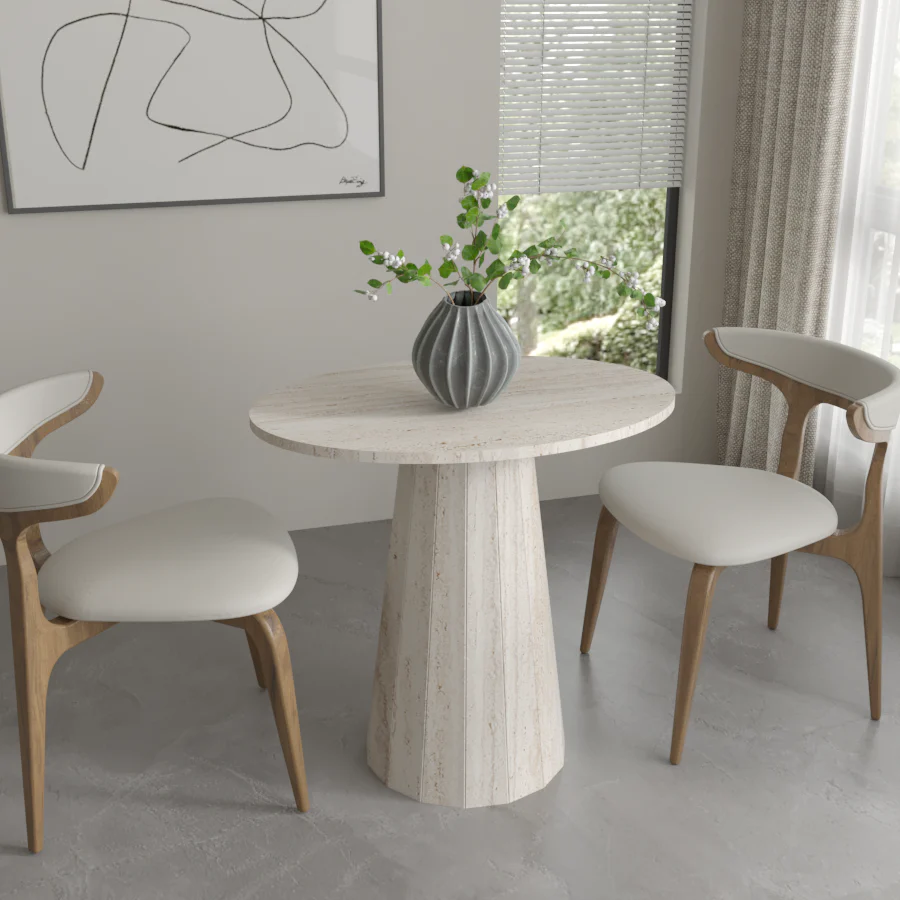
Stone furniture comes with its own language. Some terms describe the stone itself. Others describe the finish, cut, surface, edge or way a piece is made.
This glossary explains the words you are most likely to see when choosing a natural stone table, including travertine, marble, granite, honed, filled, sealed, bookmatched and veining. It is written for people choosing furniture for a real home, not for people who already work in a stone yard.
For the wider Virrelli range, explore our stone furniture, including dining tables, coffee tables and side tables handmade in England.
Natural Stone
Natural stone is stone taken from the earth, cut and finished for use. It is not a printed pattern or a man-made imitation surface.
In furniture, natural stone gives each piece its own markings, tone and movement. No two slabs are exactly the same. This is why a handmade stone table will always have more variation than a factory-made surface.
Virrelli works with natural travertine, marble and granite across stone dining tables, stone coffee tables and stone side tables.
Travertine
Travertine is a type of limestone known for warm tones, visible pores and soft natural movement. It often appears in cream, beige, ivory, honey and earthy shades.
Travertine has a calm, architectural feel. It works well in dining rooms, living rooms and bedrooms because it has weight without feeling cold.
You can see this material across our travertine furniture, including travertine dining tables, travertine coffee tables and travertine side tables.
Marble
Marble is a natural stone known for its veining, cooler surface character and smooth visual movement. It can feel more refined than travertine, with stronger contrast depending on the stone.
A marble table often becomes a clear focal point in a room. It suits interiors where the surface pattern and material presence are part of the design.
Explore our marble furniture, including pieces such as the Duomo Marble & Wood Coffee Table and the Palatino Marble & Travertine Dining Table.
Granite
Granite is a dense natural stone with a harder, more mineral appearance. It often has speckling, crystalline detail and stronger visual depth.
Granite can feel more architectural than travertine or marble. It works well for compact statement pieces, darker schemes and rooms where the furniture needs weight and contrast.
View our granite furniture, including the Saluzzo Oval Granite Side Table.
Veining
Veining is the natural line, movement or pattern seen within a stone. It is most often associated with marble, although other stones can also show movement and mineral variation.
Veining can be soft and subtle or bold and graphic. It is one of the main reasons natural stone furniture feels individual. A table with strong veining will usually draw more attention than a quieter, more consistent stone.
Pores
Pores are the small open holes or cavities found naturally in some stones, especially travertine.
They are not a defect. They are part of how the stone forms and part of the reason travertine has such a recognisable texture. Some travertine is filled to create a smoother surface. Some is left more open for a more natural look.
For everyday tables, the level of filling and sealing should be considered around use, cleaning and the desired finish.
Filled Travertine
Filled travertine has some or all of its natural pores filled to create a smoother surface. The filling helps make the stone more practical for table use while keeping the character of the material visible.
A filled finish can make sense for dining tables and coffee tables, where the surface needs to be easier to clean. The stone still keeps its natural tone, movement and variation.
Unfilled Travertine
Unfilled travertine keeps more of its natural open pores exposed. This gives the stone a more textured, raw and architectural character.
It can be beautiful, but it may not be the most practical choice for every table surface, especially where food, drink or daily cleaning are involved. For furniture, the right choice depends on the piece, finish and intended use.
Honed Finish
A honed finish is smooth and matt or low-sheen, rather than glossy. It is one of the most common finishes for natural stone furniture.
Honed stone feels calm and understated. It softens reflections and can make marble, travertine or granite feel more suitable for everyday interiors.
A honed finish can still mark if treated carelessly, so coasters, placemats and stone-safe cleaning products remain important.
Polished Finish
A polished finish has a higher shine and more reflective surface. It can make stone colours look deeper and veining appear more pronounced.
Polished marble can look formal and crisp, but it may also show scratches, etching or dull patches more clearly than a honed surface. The right finish depends on the stone and where the table will be used.
Matt Finish
A matt finish has little to no shine. It is similar in feel to a honed finish, although the exact result depends on the stone and finishing process.
Matt finishes are often chosen where the aim is to keep the furniture quiet, natural and less reflective. This can work especially well with travertine.
Sealed Stone
Sealed stone has been treated with a protective sealant to help reduce the absorption of liquids.
Sealing is important for many stone tables, especially travertine and marble. It helps protect against staining, but it does not make the surface impossible to mark.
Wine, coffee, oil, citrus and strong coloured liquids should still be wiped promptly. Sealing gives protection. It does not replace care.
Etching
Etching is a dull mark caused when acid reacts with stone. It is most often associated with marble.
Lemon juice, vinegar, wine, fruit juice and some household cleaners can cause etching. The mark may look pale, flat or less polished than the surrounding surface.
Etching is different from staining. A sealed marble table can still etch if acidic spills are left on the surface.
Staining
Staining happens when a liquid or substance soaks into the stone and changes its colour.
Oil, wine, coffee, tea and strongly coloured sauces can stain natural stone if they are left too long. Sealing helps reduce the risk, but spills should still be blotted quickly.
For care advice, read our guides on how to clean travertine tables and marble table care.
Bookmatched Stone
Bookmatching is a way of arranging two stone slabs so the veining or pattern mirrors across a join, like the pages of an open book.
It is often used in larger surfaces, feature walls and some furniture designs where the stone pattern is intended to become a major part of the piece.
Bookmatching requires careful slab selection and planning. It is not suitable or necessary for every table, but it can create a strong visual effect when used well.
Slab
A slab is a large cut piece of stone. Furniture makers use slabs as the starting point for cutting table tops, bases and other components.
Each slab has its own tone, movement, veining and usable areas. This is why stone selection matters. The finished table depends not only on the stone type, but on the specific piece of stone chosen.
Grain and Movement
In stone furniture, movement describes the visible flow, lines, clouds, bands or mineral changes within the material.
Travertine often has soft bands and tonal shifts. Marble may have stronger veins. Granite can show speckling and crystalline variation.
Movement affects how calm or dramatic a finished table feels.
Edge Profile
The edge profile is the shape and finish of the table edge.
A simple straight edge feels clean and architectural. A softened edge can feel gentler and more practical in a home. A more detailed edge may make the piece feel more traditional or decorative.
The edge has to suit the stone, the table shape and the room.
Pedestal Base
A pedestal base supports the table from a central or sculptural base rather than four corner legs.
A pedestal dining table can make seating more flexible because chairs are not interrupted by legs at each corner. It can also give a dining room a stronger central form.
The Aventino Round Travertine Pedestal Dining Table is one example of this approach in natural stone.
Round Table
A round table has no corners, which can make a room feel softer and easier to move through.
A round dining table creates a sociable arrangement because everyone faces towards the centre. A round coffee table can soften the straight lines of sofas, rugs and cabinetry.
Round forms work especially well in square rooms, smaller spaces and layouts with movement from several directions.
Oval Table
An oval table gives some of the softness of a round table, but with more length.
For dining, an oval table can offer more seating while avoiding the harder corners of a rectangle. For side tables, an oval form can provide useful surface area while keeping the outline compact.
The Ravenna Oval Travertine Dining Table and Saluzzo Oval Granite Side Table show two different uses of the shape.
Square Coffee Table
A square coffee table creates a structured centre in a living room. It works well with corner sofas, paired armchairs and seating arranged around a clear central point.
A square coffee table can feel more formal than a round design. In stone, the shape gives the material even more weight and presence.
Made to Order
Made to order means the piece is made after it has been ordered, rather than taken from mass-produced stock.
For stone furniture, this matters. The material, dimensions, finish and construction need proper consideration. A made-to-order process allows the table to be made with the room, use and stone in mind.
Virrelli furniture is handmade in England and made to order.
Bespoke
Bespoke means made around a specific brief. This could include a different size, stone, finish, base, edge or entirely new design.
A bespoke stone table may be useful for an unusual room, a particular seating requirement, a commercial project or an interior design scheme where standard dimensions are not right.
Natural Variation
Natural variation means the stone will not be perfectly uniform.
Colour, tone, pores, veining, pattern and mineral markings can all vary from piece to piece. This is not a problem to remove. It is part of the value of natural stone furniture.
A good stone table should let that variation feel considered, not accidental.
Stone Furniture FAQs
What is the difference between honed and polished stone?
Honed stone has a smoother, lower-sheen finish. Polished stone has more shine and reflection. Honed finishes often feel quieter and more natural, while polished finishes can make veining and colour appear stronger.
What does filled travertine mean?
Filled travertine means some or all of the natural pores have been filled to create a smoother, more practical surface. The stone still keeps its natural texture, tone and variation.
Does natural stone always need sealing?
Many stone tables should be sealed, especially travertine and marble. The right seal depends on the stone, finish and intended use. Sealing helps protect against staining, but it does not make the surface impossible to mark.
What is bookmatched marble?
Bookmatched marble uses two slabs arranged so the veining mirrors across a join. It can create a strong pattern, but it requires careful stone selection and is not needed for every table.
Is veining a flaw?
No. Veining is part of the natural character of marble and other stones. It is one of the reasons each table feels individual.
What does etching mean on marble?
Etching is a dull mark caused by acid reacting with the marble surface. Lemon, vinegar, wine and some household cleaners can cause etching.
Is travertine rough?
Travertine can be more textured than marble, but the finished feel depends on whether it is filled, honed and sealed. A travertine table can be made practical while still showing the stone’s natural pores and movement.
Are stone tables all the same colour?
No. Natural stone varies in tone, pattern and movement. Even two tables made from the same stone type will not be exactly identical.


