


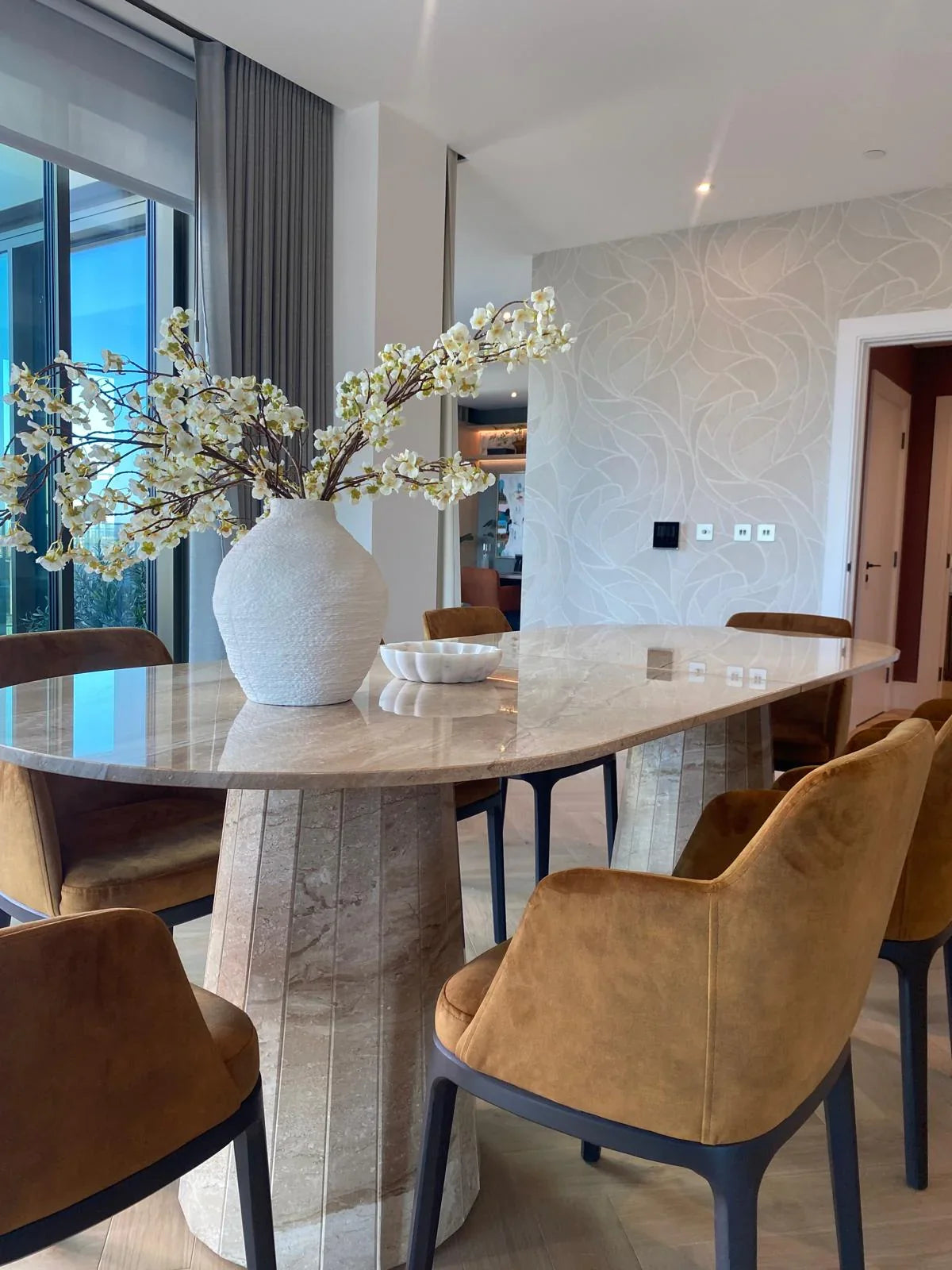
A marble effect dining table can give the look of stone from a distance, but it is not the same as a table made from real marble or solid natural stone. The difference is not only what you see. It is what the surface is made from, how it feels, how it wears and how it sits in the room.
Marble-effect furniture is designed to imitate marble. Real marble is the material itself. That distinction matters when you are choosing a dining table that should feel permanent, substantial and worth keeping.
Explore our marble furniture and stone dining tables to compare natural stone pieces made to order in England.
The Short Answer
Choose marble effect if you want the appearance of marble at a lower cost, with a lighter or more practical surface in some cases.
Choose real marble or solid natural stone if you want depth, weight, natural veining and a table that feels like the material it is made from.
Marble effect can be useful in budget furniture, rented homes, temporary schemes or spaces where imitation is enough. Real marble makes sense when the table is intended to be a long-term piece.
What Is a Marble-Effect Table?
A marble-effect table is not usually made from marble. It may be made from printed laminate, ceramic, glass, MDF, veneer, resin, composite material or another surface designed to look like marble.
The marble pattern is applied, printed or manufactured. It may look convincing in photographs, but the surface does not have the same natural depth as a real slab.
This does not make marble effect useless. It can be affordable and easy to specify. But it should be understood for what it is: a stone look, not stone itself.
What Is a Real Marble Table?
A real marble table is made using natural marble cut from the earth, finished and worked into furniture.
The veining, tone and movement are part of the stone. They are not printed onto the surface. Every slab is different, which means every finished table has its own character.
Real marble has depth. It has weight. It catches light differently from a printed surface. The edge, thickness and surface all belong to the same material.
The Palatino Marble & Travertine Dining Table shows how real natural stone can give a dining piece a more substantial presence than a surface imitation.
Real Marble vs Marble Effect: Key Differences
| Feature | Real marble | Marble effect |
|---|---|---|
| Material | Natural stone | Imitation surface |
| Pattern | Natural veining through the stone | Printed or manufactured design |
| Variation | Every slab is different | Usually repeated or controlled |
| Weight | Substantial | Often lighter |
| Surface feel | Cool, dense and natural | Depends on the base material |
| Longevity | Long-term material when cared for | Depends on construction quality |
| Repairability | Can sometimes be refinished by specialists | Often harder to repair convincingly |
| Character | Natural depth and individuality | Stone-like appearance only |
Why Real Stone Feels Different
Real stone has presence because it is not pretending to be anything else.
A marble table feels cool to the touch. It has density. Its veining moves through the stone in ways that are not perfectly repeated. The edge and surface belong to the same material.
A marble-effect surface may copy the look, but it usually cannot copy the depth. The pattern often sits on or near the surface. Edges may reveal the construction. Repeated veining can also make the table feel less natural when seen up close.
In furniture, this difference matters because a table is used from every angle. You see the top, edge, base, thickness and relationship with the room.
Natural Veining vs Printed Pattern
Marble veining is formed naturally. It changes across the slab and can be soft, sharp, cloudy, linear or dramatic depending on the stone.
Marble-effect patterns are designed to look like that movement. Some are subtle. Some are very bold. Some repeat more obviously than others.
On a small object, this may not matter much. On a dining table, it can become more noticeable because the surface is larger and seen every day.
Real marble does not repeat in the same way. The variation is part of the value.
Cost: Why Marble Effect Is Cheaper
Marble-effect dining tables are often cheaper because they use less expensive materials and faster manufacturing methods.
They may be lighter to transport, easier to mass-produce and simpler to assemble. This can make them a sensible option for some buyers.
Real marble costs more because the material itself costs more. It must be selected, cut, handled, finished, sealed and supported properly. A dining table also needs a base that can carry the stone safely.
The cost is not only for the surface. It is for the material, craft and handling needed to make the table properly.
Durability and Everyday Use
Marble-effect surfaces can be practical, but durability depends heavily on what they are made from. A printed laminate table will not behave like a ceramic table. A resin surface will not behave like glass or stone veneer.
Some marble-effect materials may resist staining well. Others may chip, peel, scratch, bubble or wear at the edges over time.
Real marble is strong, but it needs care. It can stain if spills are left on the surface, and it can etch from acidic substances such as lemon, vinegar, wine or some cleaning products.
The difference is honesty. Real marble should be treated as natural stone. Marble effect should be judged by the quality of its actual construction, not the pattern printed on top.
Care and Maintenance
Real marble needs stone-safe care.
Use a soft cloth, warm water and a pH-neutral cleaner suitable for natural stone. Wipe spills promptly. Use coasters, placemats and trays where sensible. Avoid vinegar, lemon, bleach, abrasive pads and harsh household sprays.
Marble-effect furniture may be easier to wipe clean, depending on the surface. But the care instructions will depend on the material beneath the pattern.
This is one reason to check the product details carefully. “Marble effect” describes the look. It does not tell you enough about the material.
Which Is Better for Dining Tables?
A marble-effect dining table may be better if budget, low weight or easy replacement is the priority.
A real marble dining table is better if the table is intended to be a serious long-term piece. It gives the dining room material depth, natural variation and a surface that feels connected to the rest of the object.
For dining rooms where the table is the centre of the space, real stone usually gives a more convincing result. It does not need to imitate luxury because the material already has weight and character.
View our stone dining tables and travertine dining tables for natural stone dining pieces.
When Marble Effect Makes Sense
Marble effect can make sense in the right setting.
It may be suitable for temporary interiors, lower budgets, rental properties, children’s rooms, fast-moving trends or spaces where the table is not expected to last for many years.
It can also be useful when the buyer wants a very specific printed look, low weight or a surface that does not need natural stone care.
The problem comes when marble effect is treated as the same thing as marble. It is not. It is a different product with a different purpose.
When Real Marble Makes Sense
Real marble makes sense when the table is chosen as a long-term piece of furniture.
It suits dining rooms, living rooms and interiors where natural material quality matters. It works especially well with timber, linen, wool, bronze, plaster, leather and soft architectural lighting.
Real marble is also worth considering when the table needs to feel substantial even when the room is quiet. The stone carries enough character on its own.
The Duomo Marble & Wood Coffee Table shows how marble can work with another natural material, giving the piece surface movement and depth without relying on imitation.
Real Marble, Travertine and Other Solid Stone
Real marble is not the only alternative to marble effect.
Travertine offers a warmer, softer and more textured form of natural stone. It has visible pores, tonal movement and an architectural feel. Granite gives density, mineral character and a stronger sense of weight.
For some rooms, travertine may be a better choice than marble because it feels calmer and less formal. For others, marble’s veining is exactly what the room needs.
The wider choice is not simply marble or marble effect. It is imitation surface or real material.
How to Tell the Difference
A marble-effect table may still look good, but there are signs that separate it from real marble.
Look at the edge. If the pattern does not continue naturally, or if the edge reveals a different core material, it is likely not solid marble.
Look for repeated veining. Natural marble varies. Printed patterns may repeat across the surface or look too controlled.
Check the weight. Real stone is heavy. A very light table is unlikely to be solid marble.
Read the product description carefully. Words like effect, look, style, veneer or finish usually mean the table is not solid marble.
Why Real Stone Wins
Real stone wins when the table is meant to last.
It has depth, variation and material honesty. It feels different because it is different. A solid marble or natural stone table has weight in the room, not just a pattern on the surface.
Marble effect can copy the look, but it cannot fully copy the substance. It may be useful for some budgets and settings, but it does not offer the same sense of permanence.
A real stone table asks for more care, but it gives more back: character, presence and a surface that belongs to the earth rather than a print file.
Real Marble vs Marble Effect FAQs
What is a marble-effect dining table?
A marble-effect dining table is a table made to look like marble, but not usually made from solid marble. It may use laminate, ceramic, resin, glass, veneer or another printed or manufactured surface.
Is marble effect the same as real marble?
No. Marble effect imitates the appearance of marble. Real marble is natural stone cut from the earth, with veining and movement formed within the material itself.
Is real marble better than marble effect?
Real marble is better if you want natural depth, weight, veining and a long-term piece of furniture. Marble effect may be better if you want a lower-cost, lighter or more temporary option.
Does real marble stain?
Yes, real marble can stain if spills are left on the surface. It can also etch from acidic substances. Sealing and proper care help protect it.
Is marble effect cheaper than marble?
Usually, yes. Marble-effect tables are often cheaper because they use less expensive materials and faster manufacturing methods.
How can you tell if a table is real marble?
Check the weight, edge, pattern and product description. Real marble is heavy, naturally varied and made from stone throughout. Marble-effect tables often use terms such as marble look, marble style, veneer or effect.
Is marble suitable for dining tables?
Yes. Marble can be suitable for dining tables when properly made, sealed and cared for. It should be treated as natural stone, especially around acidic food, wine, coffee and cleaning products.
What is a good alternative to marble effect?
A real marble table is the closest natural alternative. Travertine is also a strong choice if you want a warmer, softer and more architectural stone surface.


