


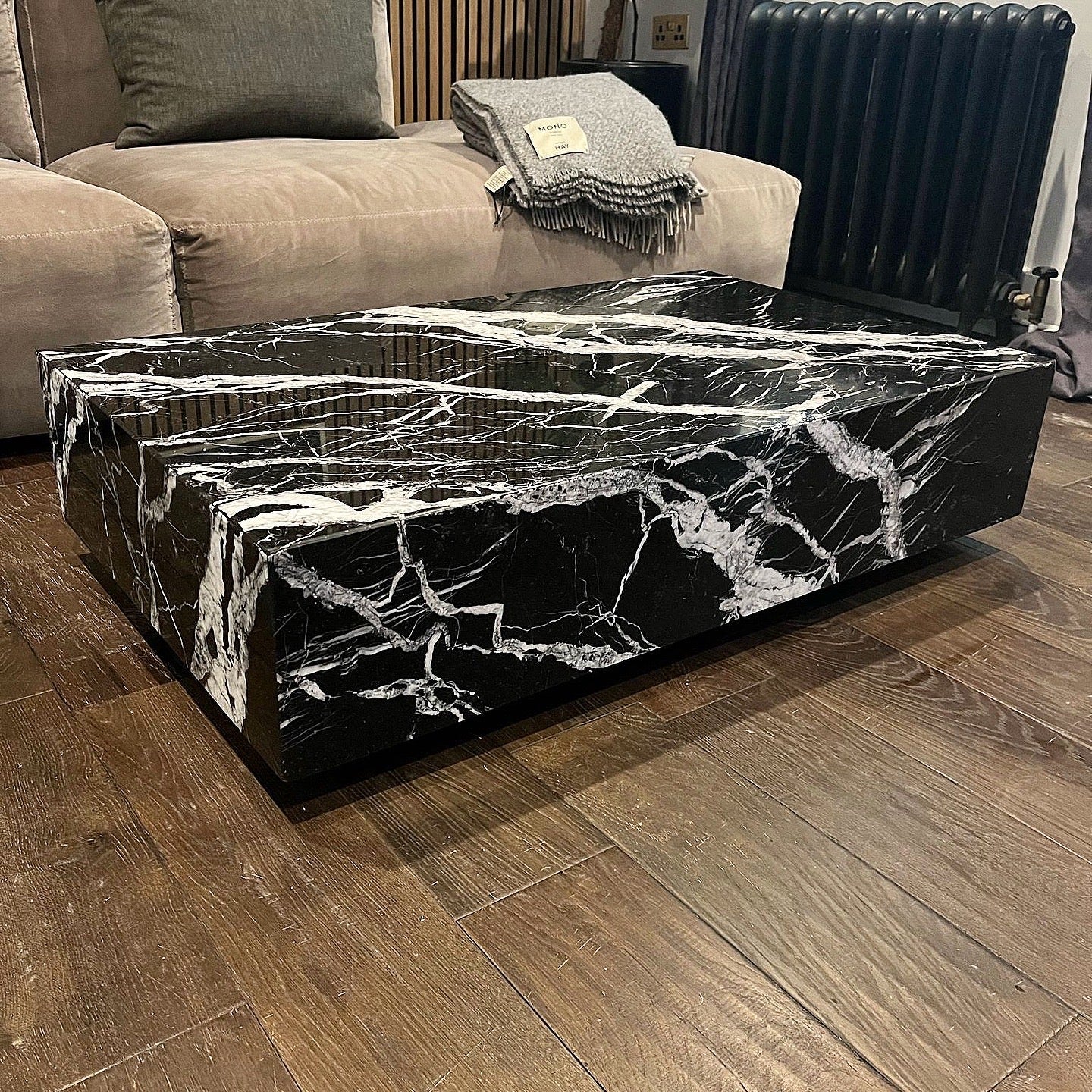
Bookmatched marble is marble arranged so the veining mirrors across two adjoining slabs, like the pages of an open book. The result can be calm and subtle, or bold and highly graphic, depending on the stone.
It is one of the most recognisable ways to use natural marble. Instead of treating each slab as a separate surface, bookmatching turns the stone’s movement into a considered pattern. It can be used for walls, panels, large surfaces and some furniture pieces where the marble itself is intended to lead the design.
For more stone terms, read our stone furniture glossary, or explore our marble furniture collection.
The Short Answer
Bookmatched marble uses two adjoining stone slabs placed so their veining mirrors across a central join.
It is called bookmatching because the slabs open out like a book. One side reflects the other, creating symmetry from the natural pattern of the stone.
Not every marble is suitable. The best results come from slabs with strong enough movement, good continuity and enough usable area to create a balanced composition.
How Bookmatched Marble Is Made
Bookmatching usually begins with consecutive slabs cut from the same block of marble. Because the slabs come from next to each other in the block, their veining and movement are closely related.
The slabs are then opened out and placed side by side. The pattern on one slab mirrors the pattern on the other, creating a symmetrical effect.
This is not simply about placing two pieces together. The stone has to be selected, cut, planned and finished carefully. The join, vein direction, usable area and final proportions all matter.
A successful bookmatch looks intentional. The eye should follow the stone naturally across the surface.
Why Bookmatching Works So Well with Marble
Marble is especially suited to bookmatching because of its veining.
Some marble has soft, cloudy movement. Some has sharper veins. Some has strong directional lines. When the right slab is mirrored, these markings can create a calm central pattern or a much more dramatic design.
The effect depends on the stone. A quiet marble may create a subtle mirrored surface. A strongly veined marble may create a more architectural centrepiece.
This is why marble selection matters. Bookmatching should bring out the stone’s natural character, not force the material into a pattern that does not suit it.
Bookmatched Marble vs Standard Marble
Standard marble uses the slab as it is. The veining, tone and movement are allowed to sit naturally across the surface.
Bookmatched marble is more deliberate. It uses the relationship between two slabs to create symmetry.
Neither approach is better in every case. A single slab may be more suitable for a table top if the stone already has a strong natural composition. Bookmatching may be better where a larger surface needs a clear centre, mirrored movement or a more formal design.
The right choice depends on the stone, the size of the piece and the room it will sit in.
Where Bookmatched Marble Is Used
Bookmatched marble is often used where the stone is meant to be a main feature.
Common uses include:
- Feature walls
- Fireplace surrounds
- Large panels
- Bathroom walls
- Kitchen splashbacks
- Reception desks
- Dining surfaces
- Bespoke furniture details
In furniture, bookmatching needs more thought because tables have edges, thickness, bases and everyday use to consider. A table is not just a flat image. It has to work as furniture from every angle.
Can Tables Use Bookmatched Marble?
Yes, bookmatched marble can be used in tables, but it is not right for every design.
A large dining table may offer enough surface area for a bookmatched layout to make sense. A smaller coffee table may not always need it, especially if a single slab already has good movement.
For pieces such as the Palatino Marble & Travertine Dining Table, the material choice and surface character are central to the table. Where bookmatching is considered, it needs to suit the proportions of the top, the base and the room.
Bookmatching should never be added just because it sounds impressive. It should improve the finished piece.
Does Bookmatching Make Marble More Expensive?
Usually, yes.
Bookmatching often requires consecutive slabs, more careful stone selection, more planning and more precise cutting. It can also create more waste, because the slabs need to be laid out around the mirrored pattern rather than used purely for maximum yield.
The cost depends on the marble, size, layout and complexity of the work.
A simple marble table may not need bookmatching. A bespoke piece with a large surface or highly visible panel may justify the extra planning.
Is Bookmatched Marble Always Better?
No. Bookmatched marble is not automatically better than a well-chosen single slab.
Some stones look better when their movement is allowed to run naturally. Some rooms need restraint rather than symmetry. Some table shapes do not suit a strong central mirror.
Bookmatching works best when the stone has the right veining and the design gives that veining enough space. If the surface is too small, too interrupted or too busy, the effect can feel forced.
The best marble furniture should feel balanced, whether it is bookmatched or not.
Bookmatching and Natural Variation
Bookmatching creates symmetry, but it does not remove natural variation.
Marble is still a natural stone. Tone, veining, small markings and mineral details will vary across the slabs. The aim is not perfect mechanical repetition. The aim is a mirrored relationship between two pieces of stone.
That is part of the appeal. Bookmatched marble sits between control and nature. The layout is deliberate, but the material remains real.
Bookmatched Marble and Other Stones
Bookmatching is most often discussed with marble, but it can be used with other patterned natural stones too.
Granite, quartzite and some limestones may also be arranged in mirrored layouts if the slabs have suitable movement. The effect depends entirely on the stone.
Travertine can sometimes show directional bands, but it is usually chosen for warmth, pores and architectural texture rather than dramatic mirrored veining.
For Virrelli, the decision would always start with the material. The stone should lead the design, not the other way round.
Bookmatching in Bespoke Furniture
Bookmatching is most relevant when a piece is being made around a specific brief.
A bespoke table, console, panel or feature surface can be planned around the slab from the start. This allows the stone, join, proportions and base to be considered together.
The process may involve reviewing slab options, choosing the vein direction, planning the centre line and deciding where the pattern should fall in the finished piece.
This is careful work. Done well, the bookmatch feels part of the furniture rather than decoration applied to it.
Marble Furniture Without Bookmatching
Not every marble piece needs bookmatching to feel considered.
The Duomo Marble & Wood Coffee Table shows how marble can work as a smaller furniture surface without needing a mirrored layout. The marble brings movement and depth, while the timber adds warmth and contrast.
For many tables, a single well-selected slab is the right answer. It can feel quieter, more natural and more suitable for everyday interiors.
Bookmatching is a tool. It is not a rule.
How to Decide if Bookmatching Is Right
Start with the scale of the piece.
A larger surface gives the pattern room to work. A smaller table may not show enough of the mirrored effect to justify the added complexity.
Then look at the stone. Does the marble have clear movement? Will the mirror feel balanced? Is the veining strong enough to matter, but not so busy that it overwhelms the piece?
Finally, think about the room. A bookmatched surface draws attention. It works best where the rest of the space allows the stone to breathe.
Bookmatched Marble FAQs
What is bookmatched marble?
Bookmatched marble is marble arranged so two adjoining slabs mirror each other across a join. The effect is similar to opening a book, with the stone’s veining reflected from one side to the other.
Why is it called bookmatching?
It is called bookmatching because the slabs are opened out like two pages of a book. One side mirrors the other, creating a symmetrical pattern.
Is bookmatched marble natural?
Yes. Bookmatched marble uses natural marble slabs. The mirrored effect comes from how the slabs are cut and arranged, not from a printed pattern.
Is bookmatched marble more expensive?
Usually, yes. It often requires consecutive slabs, careful selection, more planning, precise cutting and sometimes more waste.
Can bookmatched marble be used for tables?
Yes, but it depends on the table size, stone and design. Larger surfaces usually give the bookmatch more room to work. Smaller tables may be better with a single carefully selected slab.
Does every marble slab work for bookmatching?
No. The marble needs suitable veining, movement and slab continuity. Some stones are too quiet, too irregular or too limited in usable area to bookmatch well.
Is bookmatched marble better than regular marble?
Not always. Bookmatched marble can be beautiful, but a single slab may be more suitable for some tables and rooms. The best choice depends on the stone and the design.
Can other stones be bookmatched?
Yes. Other patterned stones can sometimes be bookmatched if the slab movement allows it. Marble is one of the most common because its veining often suits mirrored layouts.


