


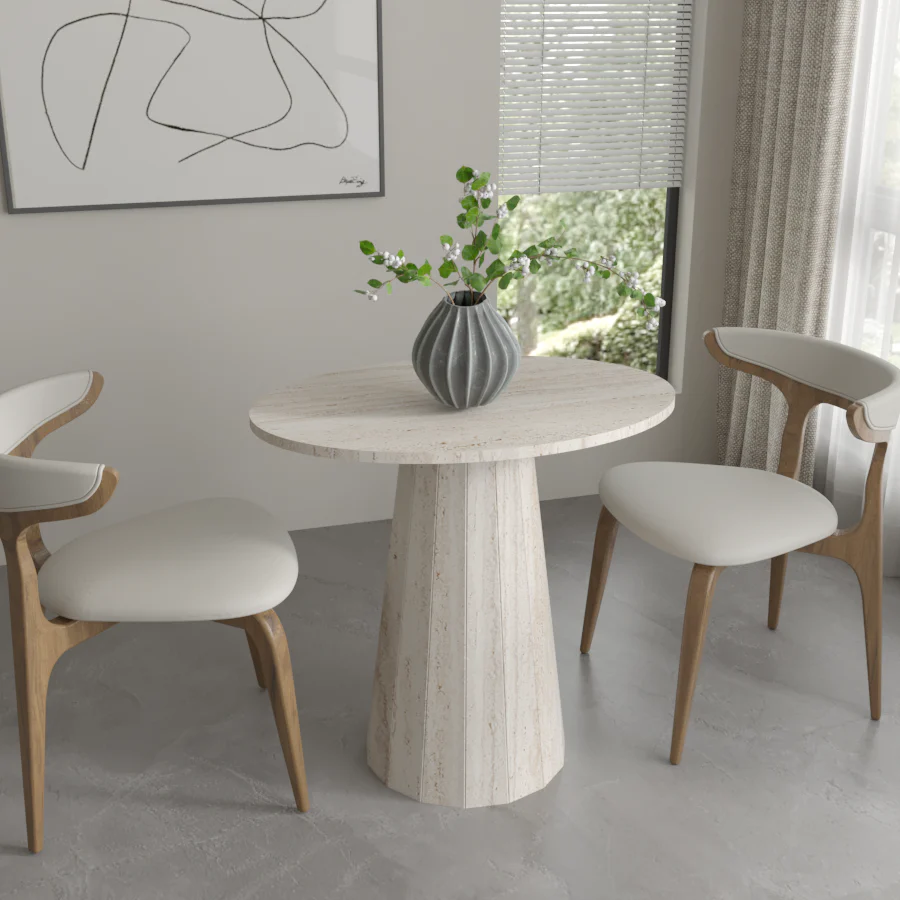
Round vs rectangular dining table choices should start with the room, not the shape you like in isolation. A dining table has to suit the space, seat people comfortably and leave enough room to move around it.
With stone dining tables, this decision matters even more. Travertine, marble and granite have natural weight and presence, so the table shape affects how the whole room feels. A round table can soften a space. A rectangular table can add structure. An oval table can often sit neatly between the two.
Explore our stone dining tables and travertine dining tables to compare shapes, materials and proportions.
The Short Answer
Choose a round dining table if you want a sociable layout, softer movement and a shape that works well in square rooms or open-plan spaces.
Choose a rectangular dining table if you need more seating, a stronger formal layout or a table that follows the length of the room.
Choose an oval dining table if you want the length of a rectangular table but with a softer outline and easier movement around the edges.
There is no single best shape. The right choice depends on room size, seating needs, chair clearance, table base and how the space is used every day.
Why Table Shape Matters
The shape of a dining table changes how people sit, move and talk.
A round table pulls everyone towards the centre. There is no head of the table, no sharp corners and no long distance between people at opposite ends. This makes it feel relaxed and sociable.
A rectangular table gives a more ordered arrangement. It suits longer rooms, larger households and formal seating. It can also work well when the room has strong architectural lines.
A stone table adds another layer to the decision. Because the material is substantial, the shape needs to feel properly placed in the room. The table should feel settled, not squeezed in.
When to Choose a Round Dining Table
A round dining table works well in square rooms, smaller dining areas and open-plan spaces where people move around the table from several sides.
It is also good for conversation. Everyone faces inwards, so the table feels more equal and relaxed. There is no obvious end seat, which can make the arrangement feel less formal.
A round table also softens the room visually. This is useful if the space already has many straight lines, such as kitchen cabinetry, doors, windows, shelving or rectangular rugs.
The Aventino Round Travertine Pedestal Dining Table is a good example of this. The round stone top gives the table presence, while the central pedestal base keeps the seating more flexible.
View our pedestal dining tables for this kind of central-base design.
When to Choose a Rectangular Dining Table
A rectangular dining table works best in longer rooms and spaces where the table needs to follow the line of the architecture.
It is often the most practical option for larger seating numbers. Six, eight or ten people can usually be arranged more easily around a rectangular table than a round one, especially when the room has enough length.
A rectangular table can also feel more formal. It gives clear ends, straight lines and a stronger sense of order. This can suit dining rooms, large kitchens, hospitality spaces and rooms with a more structured layout.
With natural stone, a rectangular table can feel very grounded. The key is leaving enough space around it so the material does not overpower the room.
When an Oval Table Is Better
An oval table is often the best middle ground.
It gives you more length than a round table, but with a softer outline than a rectangle. This can make it easier to move around, especially in open-plan dining spaces or rooms where people pass behind chairs.
An oval stone table can also feel less severe than a rectangular table of similar length. The curved ends soften the visual weight of the stone without reducing its presence.
The Ravenna Oval Travertine Dining Table shows why this shape works well. It gives the generosity of a longer dining table, but the curved form keeps it calmer in the room.
Explore our oval tables for curved stone table designs.
Room Shape: Square, Long or Open Plan
The shape of the room should guide the table.
A square room often suits a round dining table because the proportions feel balanced. The circular shape sits naturally within the space and leaves movement around the edges.
A long room often suits a rectangular or oval table. These shapes follow the length of the room and help the table feel connected to the architecture.
An open-plan space can work with any shape, but movement matters. If people need to walk around the dining area regularly, round and oval tables are often easier to live with because there are no hard corners.
Seating and Conversation
Round tables are strong for conversation. Everyone sits at a similar distance from the centre, and the layout feels less hierarchical.
Rectangular tables are more practical for larger groups, but conversation can become more divided at longer lengths. People at opposite ends may feel further apart, especially once the table seats eight or more.
Oval tables help soften this issue. They still provide length, but the curved ends make the layout feel less rigid.
For everyday dining, think about how many people use the table most of the time, not just how many might sit there at Christmas or for occasional gatherings.
Chair Clearance and Movement
A dining table needs enough space around it for chairs to pull out and people to move.
As a guide, leave at least 90cm around the table where possible. More is better in busy spaces, open-plan kitchens or rooms with routes passing behind chairs.
Round tables can make movement easier because there are no corners. Rectangular tables need more careful placement, especially near walls, cabinetry or doorways.
Stone tables should not feel crowded. Travertine, marble and granite all have visual weight, so the room needs breathing space around the table.
Pedestal Base or Legs?
The base matters almost as much as the shape.
A pedestal base can make seating more flexible because there are no corner legs. This works especially well with round tables, where chairs can be placed more freely around the edge.
Corner legs can work well for rectangular tables, but they may restrict where chairs can sit. This matters if you need to seat more people occasionally.
For stone tables, the base also needs to support the weight properly. It should feel stable, proportioned and visually connected to the top.
Round Dining Tables in Stone
A round stone dining table can feel calm and substantial at the same time. The shape softens the material, while the stone gives the table permanence.
Travertine works especially well for round dining tables because its warm tones and surface texture keep the piece from feeling too hard. Marble can make a round table feel more refined. Granite can create stronger contrast and weight.
Round stone tables suit smaller dining rooms, open-plan spaces and homes where the table is used for relaxed meals and conversation.
Rectangular Dining Tables in Stone
A rectangular stone dining table has a stronger architectural character. It can make a dining room feel more structured and permanent.
This shape works well in larger spaces where the table can sit with enough clearance on all sides. It also suits rooms where straight lines already define the layout.
The main risk is scale. A rectangular stone table that is too large can dominate the room. The table should feel generous, but not heavy-handed.
Oval Dining Tables in Stone
Oval stone dining tables are useful when you want more seating without the hardness of corners.
They work well in longer rooms, open-plan kitchens and dining areas where movement around the table matters. The curved ends help the table feel softer, while the length still gives enough space for dining.
In travertine, an oval table can feel especially balanced. The stone brings weight and texture, while the shape keeps the outline easy to live with.
Which Shape Is Best for Small Rooms?
For smaller rooms, round tables often work best. They take up space evenly, avoid sharp corners and make movement easier.
That said, a narrow rectangular table can work in a long, narrow room. The room shape matters more than the room size alone.
An oval table may also work if you need more length but want to avoid the harder corners of a rectangle.
The key is clearance. A smaller table with proper space around it will usually feel better than a larger table that makes the room difficult to use.
Which Shape Is Best for Larger Rooms?
Larger rooms can take rectangular, oval or larger round tables.
Rectangular tables are usually the most practical for eight to ten seats. Oval tables offer a softer alternative for similar numbers. Large round tables can feel impressive, but they need enough diameter and a room that can support the scale.
With stone, larger does not always mean better. The material already has presence, so the best table is the one that feels proportioned to the room.
How to Choose
Start with these questions:
- Is the room square, long or open plan?
- How many people sit there every day?
- How many people do you need to seat occasionally?
- Do people need to walk behind the chairs?
- Do you want the room to feel relaxed or formal?
- Will a pedestal base make seating easier?
- Does the table shape suit the rest of the furniture?
Choose round for softness and conversation. Choose rectangular for structure and larger seating. Choose oval when you want length without hard corners.
Round vs Rectangular Dining Table FAQs
Is a round dining table better than a rectangular one?
A round dining table is better for conversation, softer movement and square rooms. A rectangular table is better for larger seating numbers, long rooms and more formal layouts.
Which dining table shape saves the most space?
Round tables can work well in small or square rooms because they have no corners. Rectangular tables can save space in narrow rooms because they follow the length of the space.
Is a round dining table good for 6 people?
Yes. A round dining table can work well for six people if the diameter is large enough and the base does not restrict the chairs. A pedestal base can make seating easier.
Is a rectangular dining table better for 8 people?
Usually, yes. Rectangular dining tables are often more practical for seating eight or more people because they provide more length and clearer chair positions.
Is an oval table better than a rectangular table?
An oval table can be better if you want similar length but softer edges and easier movement around the room. It is a strong choice for open-plan spaces and longer dining areas.
Are round stone dining tables practical?
Yes. A round stone dining table can be practical when it is properly sized, supported and placed with enough clearance. The lack of corners can make it easier to move around.
What is the best shape for a travertine dining table?
Travertine works well in round, oval and rectangular forms. Round tables feel sociable, oval tables feel generous but soft, and rectangular tables feel more architectural.


